Thursday, May 23, 2013

Updated A.J. McCarron (QB Alabama) Scouting Report

by Justis Mosqueda

After spending some more time I wanted to do a little update on the pre-2013 scouting report I wrote on A.J. McCarron earlier this month.


Timeline:
2009: Redshirted while Greg McElroy won the starting job.
2010: Sat behind Greg McElroy, a senior, as the #2 QB. Only other QB to throw a pass besides McElroy.
2011: Beat out Phillip Sims (highly touted coming out of high school, transferred to Virginia afterwards) to be the 2011 starter.
2012: Started his second season and earned 2nd team SEC, behind Heisman Winner Johnny Manziel.
2013: Projected to start for his third year.


McCarron's size is good, in the 6'4" 215 range. While size usually is a factor in tipped passes, McCarron has a significant amount of his passes tipped compared to smaller quarterbacks. McCarron is listed as 6'4", but he's got more tipped passes than a guy like David Fales, who is in the 6'1" range. Part of this can be chalked up on the SEC schedule, but it's not going to get easier in the pros.

Obviously, McCarron's biggest plus is that he's efficient with the ball. He might not be hitting huge passes all the time, but he's got play-makers around him that can move the ball, after he throws it to them. McCarron is really safe with the ball. Having less than 1% of your drop backs intercepted on an SEC schedule is nothing to blow over. Also remember, he played in the SEC Championship and National Championship. I saw all three of his interceptions last year: one was a tipped pass off a targets hands in the Texas A&M game, another was on 4th and goal, in a do or die situation against Texas A&M, again, and the final interception was against Georgia in the left side of the end zone. In reality, I only put the fault of last one on McCarron. The other two you can't really blame him for.

A quarterback coached by Nick Saban will most likely have good mechanics and footwork. McCarron has both. Something that scares scouts is "The Saban Effect". "The Saban Effect" is a theory that because Saban is such a good coach, he gets the most out of his players, which means that who they are coming out of college is who they are going to be. No better, no worse. You get what you get, and there's very little upside. Outside of Julio Jones, it's hard to argue that any of the prospects he coached at Alabama don't support that theory. McCarron could easily fall under that umbrella. He's got everything but a big, strong arm. Unless he manages to improve arm strength by a significant amount on the pro level, there's not much more he can improve on.

His arm is the issue, though. He's got a problem hitting his guys in stride down-field because he puts too much air under the ball, and he puts too much air under the ball because he doesn't have enough arm strength to zip it in on time.

His game against Texas A&M could have been his worst in 2012. He threw two of his three interceptions against the Aggies, and Alabama received it's sole loss of the season. In the game, McCarron had four plays that were sure fire huge plays/touchdowns if he would have hit his guy in stride.

[1]

Michael Williams is being covered by the S, who had his eyes stuck in the backfield. Michael Williams becomes the deepest man on the football field and the S turned his back to McCarron.


As McCarron is passing, Williams still had the space to make the play.


The ball gets to Williams, but it didn't get to him at the right speed. Williams had to slow down for the ball, which gave the S enough time to catch up and turn to make the deflection.


Here's a closer look at the deflection.


[2]

The next play involves Amari Cooper. Cooper is running a deep route when the CB, who was on an island covering him, slips and Cooper is left wide open down-field.


When the pass is made Cooper has plenty of space to make a play after the catch.


The pass was behind Cooper, who has to slow down and turn back for the catch. The DB catches up to him at the 45, and Cooper gets very little YAC on the play, due to the pass being behind his stride.

[3]

Unlike the last time McCarron had Cooper open, he hit him perfectly in stride.


It resulted in a touchdown.


[4]

This is the biggest mistake McCarron had, in my opinion. Kenny Bell broke coverage with around 4 minutes left in the forth quarter, when the Crimson Tide were down 4 points.


McCarron, again, put too much air under the ball. Not only did one defender catch up to him, but two did. Bell went down as soon as he caught the ball.


After that catch, Alabama was set up with a 1st and Goal in a "must get a touchdown" situation. They failed to make it in their first three tries, leading to a do or die 4th and Goal situation. McCarron threw a strike to the right-side of the endzone, which resulted in that interception where the DB ripped the ball out of the WR's hand that I talked about earlier. If McCarron would have hit Bell on that pass, it's easy to assume they would have gone up 2 with less than 4 minutes left, instead of falling to Texas A&M's feet on a goal line interception.

McCarron really only threw a good pass on one of four coverage fails by Texas A&M. Even though he connected on three deep passes, he left potential points on the table three out of four times.

He needs to become more consistent on the deep throws. His arm strength just isn't up to par with the rest of his game. While he can get the ball to a target on deep plays, a majority of the time it's rainbow throws. If you look at short, accurate throws like swings and screens, you can also see his lack of velocity on the ball, there.

McCarron does have really nice accuracy, though, and is extremely well off of the play action and to the right side of the field. I'm not sure there is someone I would trust working on the right sideline more than him this class. Working outside of the pocket on rollouts might be better for him.

Actually, I charted six of his games and it reflected my thoughts on his left v right side passing:


Here's the combined chart:


And here are charts looking at his usage of the field:


He uses the right side of the field almost 40% of the time and throws the ball ten yards or less around 68% of the time.

For a guy that does a lot of good stuff outside of the pocket, he's not speedy, per se, but he's mobile enough to make some plays (often tries to make something out of nothing and ends up getting nothing, though) and seems more comfortable throwing deep passes while rolling right. What's weird is that when he's running with the ball, he always looks like he's losing his balance. Looks really awkward running the ball.

While he throws mostly out of the shotgun, I wouldn't be surprised if he succeeded in an action heavy under-center offense on the pro level. Very rarely do you see shotgun heavy guys transitioning better in an under-center pro offense, but he could be the exception.

Besides hiding his deep ball behind the talent of his teammates, there is a question of what he'll do under pressure, just because his offensive line was so good. The strong running game of Alabama also kept defenses more honest, which meant fewer blitzes for him. When he is pressured, he tries to do too much with his legs, instead of making plays with his arm against the defense with less than idle amount of men in coverage.

Overall, he's a solid, efficient college quarterback that needs to work on his deep ball, but he could be a solid "game manager" at this point. There are rumors that he scored in the 3rd-4th round range in the Draft Advisory Board's projection. That's basically where I imagine he would be drafted this year. He's got time to improve, though. I think he is most likely a late Day 2/Day 3 prospect, but we'll learn a lot more about McCarron in 2013, after losing his starting RT, LG, C, TE, and RB in the 2012 NFL Draft.


Justis Mosqueda's current 2013 quarterback rankings:
David Fales San Jose State 1st Round grade
A.J. McCarron Alabama Late Day 2/Day 3 grade
Tajh Boyd Clemson Late Day 2/Day 3 grade
Aaron Murray Georgia Day 3 grade
Logan Thomas Virginia Tech Day 3 grade


Justis Mosqueda is a Journalism student that writes for DraftFalcons.comPackers-Backer.blogspot.com, and cuts videos of NFL Draft prospects for DraftBreakdown.com

You can follow Justis on Twitter: Twitter.com/justismosqueda

Wednesday, May 22, 2013

The Double R Theory

by Justis Mosqueda

I'm not one to believe in curses, but one has fallen on the Green Bay Packers organization. I'm not sure why someone hasn't connected the dots prior to this, but it's pretty consistent.

Since the selection of Darren Sharper in the second round of the 1997 NFL Draft, every single Packers draft pick with two consecutive R's in his name has busted, up until this point.

1997 7th round pick Terrance Lucas: There is no evidence besides draft records that Lucas ever was even a Packer.

1998 6th round pick Scott McGarrahan: Played special teams with the Packers, before leaving after 3 years.

1999 6th round pick Scott Curray: Played in five games in two season with Green Bay before calling it a career.

2000 3rd round pick Steve Warren: Spent several seasons on the PUP or IR lists before having to retire in 2003 due to the injuries he sustained.

2000 4th round pick Gary Berry: Returned one kick in his one year with the Green Bay Packers.

2001 3rd round pick Torrence Marshall: After facing a suspension in 2003 and IR in 2004, Marshall was out of the league by 2005, playing the AFL from 2006-2007.

2001 4th round pick Bill Ferrario: Only was on the team from 2001-2002. The last time he saw playing time was in his second season in the league.


Now here is when things start to get scary accurate. You can argue that those guys were all late round picks, which usually don't pan out, but here comes almost every major bust in the past decade for the Packers:


2004 1st round pick Ahmad Carroll: The 1st round pick lasted less than two and a half years with the Packers, before getting cut. Last year he bounced around on two AFL clubs and the Toronto Argonuats roster.

2005 2nd round pick Terrence Murphy: Murphy, the once promising WR, caught five passes before his spinal stenosis diagnosis his rookie year. He played one season with the Packers.

2007 1st round pick Justin Harrell: This was basically the reaction to the Harrell selection-> https://www.youtube.com/watch?v=W_dBns0i2vw Even though he did manage to be on the roster for four years, Harrell's career was covered with injuries that kept him off the field.

2007 7th round pick Clark Harris: Harris didn't even make the Packers roster.

2011 1st round pick Derek Sherrod: After breaking his leg his rookie year, he's still not ready to see the field. 2010 1st round pick Bryan Bulaga recently made the move to LT, making Sherrod's future in Green Bay questionable.

2012 1st round pick Nick Perry: Nick Perry was having an okay season in 2012, his rookie year, until he broke his wrist in Week 6, forcing him to go on the IR list.

2012 4th round pick Jerron McMillian: Nothing has happened to Jerron McMillian as of yet. :knocks on wood:

2012 5th round pick Terrell Manning: Contracted an illness during the pre-season his rookie year. Only was active in five games last season, racking up a total of 3 tackles when Desmond Bishop and D.J. Smith (both were projected as starters at one point in the year) were IR'd.

2013 7th round pick Sam Barrington: Nothing has happened to the rookie as of yet. Joins McMillian as the only exceptions to the rule, so far. :knocks on wood:

If you expand the list to guys with two R's in their names, period, it's a little different. While Aaron Rodgers and Donald Driver are on the list, the rest could be argued as busts. Some guys, like Corey Rodgers, never really saw the field. Others, like Allen Barbre, saw the field, but were just not very good at football.

The list:

1998 5th round pick Corey Bradford
1999 5th round pick Craig Heimburger
1999 7th round pick Donald Driver
2005 1st round pick Aaron Rodgers
2006 4th round pick Corey Rodgers
2007 4th round pick Allen Barbre
2013 4th round pick J.C. Tretter

The last name on the list is J.C. Tretter, the offensive lineman that broke his ankle during OTA's this week.

The curse is real, it's time to alert Jerron McMillian and Sam Barrington.


Justis Mosqueda is a Journalism student that writes for DraftFalcons.comPackers-Backer.blogspot.com, and cuts videos of NFL Draft prospects for DraftBreakdown.com

You can follow Justis on Twitter: Twitter.com/justismosqueda

Tuesday, May 21, 2013

A.J. McCarron's Passing Chart


by Justis Mosqueda

One of the best ways to scout (or grade) quarterbacks is using a passing chart. A passing chart is used to separate the outcomes of passes in certain areas, by a quarterback. Instead of giving you a flat completion percentage, a passing chart will tell you exactly where a guy completes most of his passes, and where he comes up short.

The chart is broken up into four rows: passes where the ball goes more than 20 yards, passes where the ball goes between 11-19 yards, passes where the ball goes 0-10 yards, and passes where the ball is thrown behind the line of scrimmage. There are also three columns: left of the hash marks, between the hash marks, and right of the hash marks. This allows passes to be separated into twelve different possibilities that the chart could focus on.

To chart A.J. McCarron's passes I used videos off of DraftBreakdown.com. I passed up on the Western Kentucky game (because they aren't a BCS opponent), but I did manage to chart McCarron against Notre Dame, Texas A&M, LSU, and Georgia. Arguably the best competition he faced all year.

I did take out throw-away passes and spikes out of consideration when I was making his chart, so they aren't included.

Here are the results:


When I tallied up the results I got this combined chart:


As you can see, McCarron is much better on the right side of the field, using the sideline well like I stated in my early scouting repot on him (which you can find here: http://packers-backer.blogspot.com/2013/05/quick-thoughts-on-aj-mccarron-qb-alabama.html). The further down-field and left the ball gets, the less accurate he is, except deep, when passes are usually made due to blown coverages.

To refine the numbers a little more, I added competition percentage (color coated, warm=good, cool=bad, grey=medium) and yards per attempt, in each category:


Justis Mosqueda is a Journalism student that writes for DraftFalcons.comPackers-Backer.blogspot.com, and cuts videos of NFL Draft prospects for DraftBreakdown.com

You can follow Justis on Twitter: Twitter.com/justismosqueda

Monday, May 20, 2013

Packers Go to the Rookie Premier

By Justis Mosqueda

The NFL Rookie Premier was this weekend, at the Rose Bowl. The Rookie Premier is an event where the rookie suit up for Topps, and take pictures for their rookie cards. The Packers had runningbacks Eddie Lacy and Johnathan Franklin at the event. I compiled some of the shots that were taken from this weekend.


 4th round pick Johnathan Franklin's Score card.


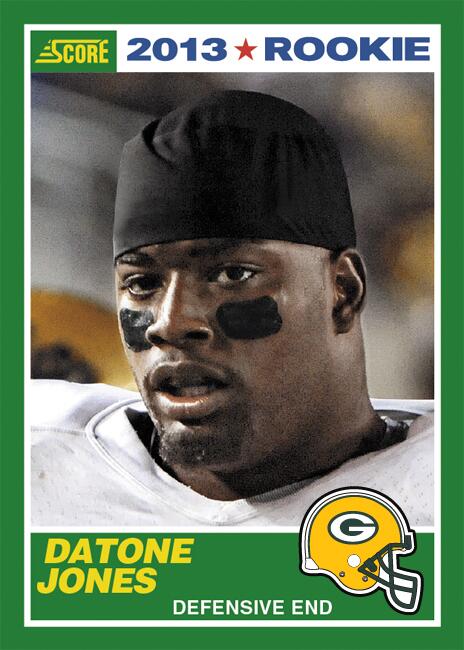
1st round pick Datone Jones's Score card.

2nd round pick Eddie Lacy's Score card.

Johnathan Franklin holding up an autographed Panini card.

Johnathan Franklin interviewing a Buffalo Bill.

Johnathan Franklin signing autograph cards for Panini.

Eddie Lacy in action at the Rose Bowl

Eddie Lacy signing a Panini card.


A dual Johnathan Franklin and Eddie Lacy Panini card.

Eddie Lacy interviewing Denard Robinson.

All the photos came from @ToppsFB, @DanRubenstein or @PaniniAmerica on Twitter.


Justis Mosqueda is a Journalism student that writes for DraftFalcons.comPackers-Backer.blogspot.com, and cuts videos of NFL Draft prospects for DraftBreakdown.com

You can follow Justis on Twitter: Twitter.com/justismosqueda

Thursday, May 16, 2013

Logan Thomas (QB Virginia Tech) Pre-2013 Scouting Report


By Justis Mosqueda

Timeline:
2009: Logan Thomas redshirted his first year at Virginia Tech while Tyrod Taylor (2011 6th round pick of the Baltimore Ravens) was starting.
2010: Was a backup quarterback while Tyrod Taylor was in his senior year.
2011: Took over the starting job and was named 2nd team ACC (behind Clemson's Tajh Boyd).
2012: Slipped the next season, but did hold onto the starting job.
2013: Projected to start his third year.


At one point, Logan Thomas was Mel Kiper's number one quarterback. Since that projection, Thomas's stock has come crashing down in the draft community. He really wasn't the Cam Newton everyone was expecting, but a more mobile, much less polished, version of Ben Roethlisberger. At this point Logan Thomas is a project quarterback that you have to completely rebuild.

While he's got a good frame (6'6", around 255), he's one of the least exciting passers with "an arm". Not only does Thomas not take advantage of his arm, he overthrows his targets in intermediate throws that will more than likely be interceptions on the next level. Heck, look at this play for example:


There was no one near where he threw the ball, and the defender gets both hands on the pass. Logan is lucky that one wasn't counted as an interception.

Actually, looking back at 2011, Thomas might have been more lucky than good. Like this play:

Thomas rolls left on a 3rd and 13.


Instead of keeping his eyes down-field, Thomas locks eyes with the pass rusher running right at him. He doesn't get his feet set to make a pass, he just stares at him for a second. Notice the other rusher on the 20 that is free.


Not able to run right to buy time (because of the other rusher), Thomas twists, looks up, and heaves it deep, all in one motion. Everything looks sloppy.


The ball gets to the target (whom Thomas may have seen a half a second before he threw the ball) with enough power for him to make the jump ball "50/50" catch.


Thomas's "good" 2011 statistics don't show his sloppy progression, just a completion for about 25 yards. I think Thomas regressed toward the mean, rather than him actually dropping off in 2012. He threw more passes, more interceptions, less touchdowns, ran for less touchdowns, and got sacked more in 2012 than he did in 2011. I don't think he got worse, I just think he wasn't all that great a year before then, either.

Thomas has all the tools you technically need to be a good quarterback on the NFL level: a big arm, a tall frame, and mobility. His lack of accuracy, poor throwing motion, and poor decision making makes him a tough read, though. He was recruited out of high school by many colleges as a tight end. Maybe that's where he belongs in the pros. If he tests well at the combine, I'd bet there would be someone in the league willing to take a shot on him.

If Logan Thomas is willing to convert to tight end (which most quarterbacks aren't), I could see him going in late Day 2. Until then, Logan Thomas looks like a late Day 3 pick that has to spend a year or two on the practice squad before he should even be allowed to see number two duty on the depth chart.


Justis Mosqueda's current 2013 quarterback rankings:
David Fales San Jose State 1st Round grade
A.J. McCarron Alabama Late Day 2/Day 3 grade
Tajh Boyd Clemson Late Day 2/Day 3 grade
Aaron Murray Georgia Day 3 grade
Logan Thomas Virginia Tech Day 3 grade


Justis Mosqueda is a Journalism student that writes for DraftFalcons.comPackers-Backer.blogspot.com, and cuts videos of NFL Draft prospects for DraftBreakdown.com

You can follow Justis on Twitter: Twitter.com/justismosqueda

Wednesday, May 15, 2013

Aaron Murray (QB Georgia) Pre-2013 Scouting Report


By Justis Mosqueda

Timeline:
2009: Redshirted his first year at Georgia.
2010: He and Zach Mettenberger (now LSU's starting quarterback) battled for the starting spot before Mettenberger was kicked off the team. Murray was named to several freshman All-American teams after his 2010 season.
2011: In his second year as a starter, Murray earned 2nd team All-SEC behind Tyler Wilson (2013 Raiders 4th round pick).
2012: Had a slight slump in progression in 2012 and was named to several 3rd team All-SEC teams, behind the Heisman-winning Johnny "Football" Manziel and back to back National Champion, A.J. McCarron.
2013: Projected to start for his forth year. 


Aaron Murray is much smaller than the prototypical quarterback. He's listed as 6'1", but it wouldn't surprise anyone if he was measured in at 6'0". That is a problem, but it can be overcome. While I'm not willing to let it just slide, I don't think it carries as much weight as many think it does.

I don't really understand the Aaron Murray hype, to be honest. Gil Brandt and Tony Dungy both said he's their number one senior quarterback of the class. While I respect both of them, I don't agree.

Dungy even went on about Murray's work-ethic, saying it was Peyton-like. You can see it in some parts of Murray's game, like the play action. Murray has one of the best fake hand-offs outside of Denver, but that does not make a quarterback.

Actually, for as efficient as Murray is (most TDs and least interceptions in the 2nd half of games in 2012, by QB's with 100+ passing attempts), he really looks like he's more comfortable outside of the pocket than inside of it. Murray played in a hybrid under-center/shotgun system, but when he took under-center snaps the PA and rollout game really helped him. He doesn't have the biggest arm and the rollout helps him gain momentum (power) to throw the deep ball. His non-rollout deep balls seemed to have too much air under them.

Aaron Murray is slightly athletic. Not the zone read type, but he's "functionally mobile". Unfortunately for him, he tucks the ball vs the rush like he's an elite athlete. He's not very good under pressure and that's because he doesn't really get the ball off. Instead of throwing vs fewer men in coverage, he tucks the ball and often gets sacked. That leads me into another issue I have with Murray: he locks onto receivers. I know Dungy compared Murray to Peyton, but the way Murray reads defenses seems so far away from what Manning does I just can't buy it.

If you would have told me Murray has the most yards per drop back of any senior quarterback in the class, I wouldn't believe it. If you would have told me Murray had the most second half touchdowns of anyone in college football, I wouldn't believe it. If you would have told me Murray had the least second half interceptions for a quarterback with over 100 passes, I wouldn't believe it. That's just not his game, and I'm not sure how he's managed to put up those numbers in SEC play, to be totally honest.

Overall, Murray is just a quarterback that is slightly above average in about every category. He's got an okay arm, he's got okay accuracy, he's got okay feet, but he can't really read defenses well enough to take advantage of what they give him. If you're a 6'1"/6'0" quarterback in the SEC, you have to take everything that the defense gives you. He's just a quarterback that peaked early, won an SEC starting quarterback spot as a freshman, and has been over-hyped the last year.

Justis Mosqueda's current 2013 quarterback rankings:
David Fales San Jose State 1st Round grade
A.J. McCarron Alabama Late Day 2/Day 3 grade
Tajh Boyd Clemson Late Day 2/Day 3 grade
Aaron Murray Georgia Day 3 grade
Logan Thomas Virginia Tech Day 3 grade


Justis Mosqueda is a Journalism student that writes for DraftFalcons.comPackers-Backer.blogspot.com, and cuts videos of NFL Draft prospects for DraftBreakdown.com

You can follow Justis on Twitter: Twitter.com/justismosqueda

Tuesday, May 14, 2013

Packers Possibly Using the Pistol in 2013?

By Justis Mosqueda


Yesterday, Chris Ault was hired by the Kansas City Chiefs as a "Consultant". The first thing I though was: "Crap, I wish the Packers would have nabbed him." Dubbed as the Pistol Godfather, Ault really did change the game. In 2005 he started using the pistol formation at Nevada, which has since been modified for NFL usage. Last year, the 49ers took the pistol formation and a former Ault quarterback, Colin Kaepernick, to the Super Bowl. In eight years, the pistol went from being used at one FBS school, to used as the primary offense of a Super Bowl team. Much of this is due to the success that Ault had with the system at Nevada.

Kaepernick is burned into the eyes of Packer fans. His 181 rushing yards and 263 yards through the air ended the Packers 2012 season and their championship hopes. The defensive staff responded by traveling south to College Station to talk to Texas A&M's staff about the spread offense and the zone read. Their new head coach, Kevin Sumlin, helped transition A&M to SEC success. The Aggie quarterback by-product was Johnny "Football" Manziel, the first freshman Heisman winner in college football history. While Rodgers is an athletic quarterback, there's no way the Packers are going to make him into an option quarterback, like Manziel is in College Station.

The fact that the Packers went down to talk to offensive college coaches to find out how to stop their system made me instantly react to Ault the same way. I thought that he was going to be a preventative consultant for the Chiefs, trying to aid them into stopping the pistol, not installing it. I was wrong. It was announced today that the Chiefs were going to run the pistol offensively, Ault even noted, "Alex Smith could run the read system."

A couple years ago, coaches were claiming that the pistol would be the next college innovation that would make the jump to the pros. Those people were right, the NFL wants in.

Along with Kansas City, Green Bay was one of three teams that offered Ault, but couldn't get him (the other two being Baltimore and Minnesota.) There is possibly more teams as Dan Wetzel, a writer for the New York Times, stated in February that Ault was tied to as many as six teams at the combine.

Why did Kansas City get Ault, but Green Bay didn't? Is it because the Chiefs offered him an offensive position and the Packers offered him a defensive position? We'll never know.

That got me thinking. I know the Packers looked very bad vs the zone read against both San Francisco and Minnesota. I know they did go to College Station to study up on how to stop it. I know Ault did turn Green Bay down. I know Rodgers isn't ready to run the ball with a 110 million dollar tag on his head, but maybe, just maybe, they wanted Ault to see if they could integrate the pistol into their offense.

The idea isn't as crazy as you'd think. I'm not saying that Rodgers would tuck it and run twenty times a game. While the pistol is connoted with the zone read, there are benefits that the pistol could give non-read offenses. The simple fact that the running back could run left or right would make the Packers running game more of a threat that it was in 2012, when five different running backs started for Green Bay.


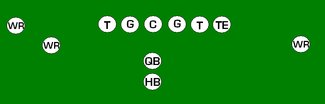
That's really what the pistol is about. Balance. The running back lines up behind the quarterback, instead of on the sides. Say the running back is lined up to the right of the quarterback in the shotgun, he'd have to go left to get the ball, lose momentum, then turn right if he wanted to go right. In the pistol the running back acts the same as he would in a single back formation, but the quarterback gets a cheat by being back a few yards (about 4 yards from the center), not having to make so many steps to drop back. The quarterback is still deeper in his drop back than under-center snaps, and the defense doesn't know which way the running back is going to go.

Defensive football is about two things: cheating and gambling. Defenses weren't balanced against the 2012 Packers. They were allowed to "cheat"due to the poor running game. The poor running game lead to a poor play action game, in which Rodgers had worse stats in than the normal non-action passes. That's a punch to the gut. Play action stats are almost universally better than "normal" passing stats, but the now highest-paid player in the NFL was actually worse in those situations.

I'm not willing to bet anything on this, but it would not shock me to see the Packer running some variation of the pistol in 2013. McCarthy tends to try to stay ahead of the curve on the offensive side of the ball, and Rodgers could produce well in the pistol. I'm not sure if this matter at all, but Eddie Lacy, the 2013 second round pick out of Alabama, ran a lot of single back in college, and Johnathan Franklin, the 2013 forth round pick out of UCLA, ran two years of the pistol system in college. With the potential top two running backs on the depth chart running a similar system in college it would make the transition easier, wouldn't it?

The possibility is very much real, in my opinion. If the Packers ever want to experiment with Rodgers in the pistol, the time is now.


Justis Mosqueda is a Journalism student that writes for DraftFalcons.comPackers-Backer.blogspot.com, and cuts videos of NFL Draft prospects for DraftBreakdown.com

You can follow Justis on Twitter: Twitter.com/justismosqueda